Signal vs. Noise: Stock Market Concentration Concerns
The Player or the House?
We’re in the Hospitality Business
Client-Exclusive Webinar with David Booth, Co-Founder and Chairman of Dimensional
A Good Estate Plan Should Make Life Easier
Category: Uncategorized
Closing the Gap
Why the biggest challenge in investing is seeing clearly.
20+ years ago, I was sitting in a conference room when my former boss abruptly stopped the conversation. He wasn’t an imposing man physically. In fact, he was rather petite. But when he decided to make a point, the entire room listened. Looking directly at me, he said, almost as if he wanted to make sure I’d remember it years later: “Perception is reality.”
I remember thinking, That can’t be right. Surely reality wasn’t determined by how someone happened to perceive it. For years, I resisted the lesson.
Eventually, though, I realized there was a deeper truth inside it. My boss wasn’t saying facts don’t matter. He was reminding me that our decisions are driven by how we interpret those facts. I’ve thought about that conversation many times over the years, and it cropped up again recently when I came across a fascinating chart:
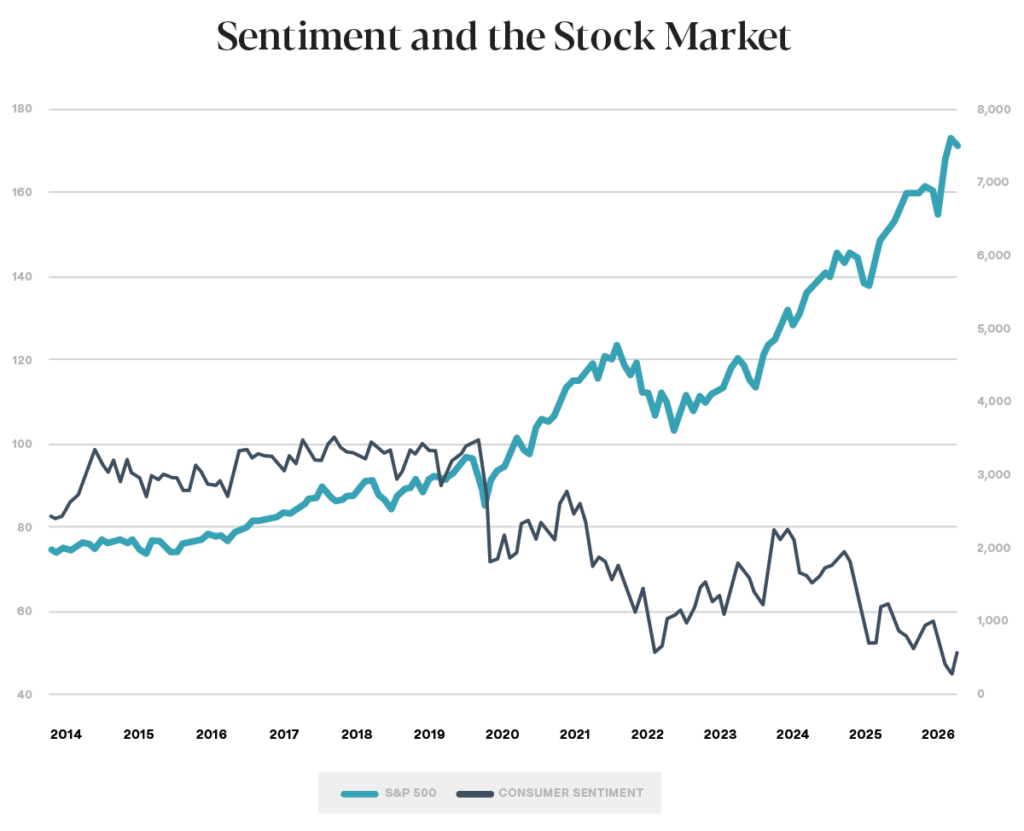
The chart compares consumer sentiment (how we feel) with the performance of the U.S. stock market over the past 13 years (what happened). Intuitively, you’d expect the two to move together. If Americans are becoming wealthier, surely we should feel better. Instead, the two lines move in almost opposite directions.
Markets have boomed, retirement accounts have grown, investment portfolios have appreciated, and yet consumer sentiment is down…way down. Some investors feel worse even as they have, in many cases, been getting richer.
That disconnect reminds us that the hardest part of investing often isn’t what the market is doing. It’s accurately perceiving what’s happening while we’re living through it.
Every day we’re bombarded with information designed to capture our attention—not improve our judgment. Headlines compete for clicks. Social media rewards outrage. Every scroll offers another crisis, another prediction, another reason to worry.
At the same time, businesses continue to innovate. Workers continue to create value. Companies continue to earn profits. Diversified investors quietly participate in that growth.
Both realities exist at the same time.
The question is which one shapes our decisions.
That question, I believe, gets to the heart of investing. Because the biggest challenge isn’t finding great investments. It’s keeping our perception aligned with reality long enough to benefit from them.
Good advice doesn’t eliminate uncertainty. It helps us respond to uncertainty in better ways. It encourages patience when fear is loud. It provides perspective when the news cycle is overwhelming. It reminds us that our greatest investment decisions are rarely made in moments of excitement or panic, but through the quiet discipline of sticking with a thoughtful plan. It’s not exciting. It’s often downright boring. But it’s true. And over long periods, it’s remarkably effective.
We often talk about closing the gap between investment returns and investor returns. Investors frequently underperform the very investments they own because their perceptions lead them to buy and sell at exactly the wrong times.
Maybe that’s really just a symptom of a deeper gap.
The gap between perception and reality.
At Hill, you know what we call this idea. We call it taking the long view.
And by the way, I eventually realized my old boss was only half right.
Perception isn’t reality. But perception drives behavior. And behavior shapes outcomes.
Markets don’t require us to be smarter than everyone else. They don’t ask us to predict elections, guess interest rates, or identify the next Nvidia before anyone else. They ask something much simpler: to see clearly.
Our job isn’t simply to manage portfolios.
It’s to help our clients close the gap between perception and reality so they can capture more of what the markets have been offering all along.
Podcast Spotlight: Evidence-Based Perspectives in Today’s Markets
Markets continue to generate plenty of headlines – from AI and rising stock prices to questions about whether a handful of companies have become too dominant.
In a recent conversation on the Excess Returns podcast, our HIG and Longview Research Partners CIO Matt Zenz discusses how an evidence-based investment process helps investors stay focused on what matters most, without relying on predictions or market timing.
Topics include:
- Should today’s market concentration should concern long-term investors?
- Why do valuations matter, and when do they matter most?
- How thoughtful implementation can improve long-term investment outcomes.
- Why taxable fixed income may be one of the biggest remaining opportunities to improve after-tax returns.
The discussion also explores Longview’s philosophy behind the Longview Advantage ETFs, including EBI and LVIG, and why disciplined implementation can add value over time.
Listen to the full conversation here:
We Asked a $1 Billion Quant Manager Why Concentration Isn’t a Warning — and Small Caps Aren’t Dead.
Or listen on Spotify or Apple Podcasts.
Prospectus can be found by visiting this page.
You should consider the investment objectives, risks, and charges and expenses carefully before you invest in the Longview Advantage Fund (the “Fund”). The Fund’s prospectus or summary prospectus, which can be obtained by visiting www.longviewresearchpartners.com, contains this and other information about the fund, and should be read carefully before investing.
Investing involves risk, including possible loss of principal.Fixed Income Securities Risk. Fixed-income securities are subject to the risk of the issuer’s inability to meet principal and interest payments on its obligations (i.e., credit risk) and are subject to price volatility resulting from, among other things, interest rate sensitivity, market perception of the creditworthiness of the issuer, willingness of broker-dealers and other market participants to make markets in the applicable securities, and general market liquidity.Distributed by Quasar Distributors, LLC. Quasar is not related to Hill Investment Group Partners, LLC d/b/a Longview Research Partners, the fund’s Investment Adviser.
Pay Yourself First

Is your cash working as hard as it could be? Many checking and savings accounts still pay very little interest. That’s why we recommend Flourish, a high-yield cash account for everyday cash and short-term savings (we use it ourselves, too). It keeps your money accessible while earning a competitive rate.
For a limited time: If you set up direct deposit into Flourish before the end of 2026, you’ll earn a boosted interest rate for your first 90 days. It costs nothing and only takes a few minutes to activate.
After the promotional period ends, your cash will continue to earn Flourish’s competitive standard rate rather than sitting in an account paying little or no interest.
At Hill, we believe the best financial strategies are often the simplest ones. Small changes like earning more on your cash and automating good financial habits can make a meaningful difference over time.
If you’d like help getting started with Flourish or setting up direct deposit, recurring transfers, and other automations, we’re happy to help. Please reach out to us.