Signal vs. Noise: Stock Market Concentration Concerns
The Player or the House?
We’re in the Hospitality Business
Client-Exclusive Webinar with David Booth, Co-Founder and Chairman of Dimensional
A Good Estate Plan Should Make Life Easier
Category: Values
Meet Annie Hall

We’re excited to welcome Annie Hall as Marketing Manager at Hill Investment Group and Longview Research Partners after a year of working with our team. Annie’s role spans marketing, growth, and business development across both organizations, including content and editorial planning, client communications, digital marketing, events, and business development coordination.
Annie brings more than a decade of experience across sales, design, technology, and entrepreneurship. During 12 years in Chicago, she spent a decade at luxury design company HOLLY HUNT before moving into technology sales at climate tech company Worldly. She later launched her own business, working independently with leaders and growing companies. That range of experience shapes how she approaches communication, relationships, and bringing ideas to life.
For Annie, joining Hill full time is also a return to familiar ground. I’ve known her since she interned with us in 2009, before graduating from the University of Missouri with a degree in Biology and a minor in Architectural Studies. As co-founder Matt Hall’s younger sister, she also had a front-row seat to Hill’s early days.
Now back in St. Louis, Annie lives with her partner, Nate, and their two rescue dogs. A lifelong tennis player and outdoor enthusiast, she is passionate about animal rescue and is currently training for her first marathon this year in Chicago! See Annie’s full bio here.
Living Our Values: Reflections From Hill’s 2026 Summer Interns
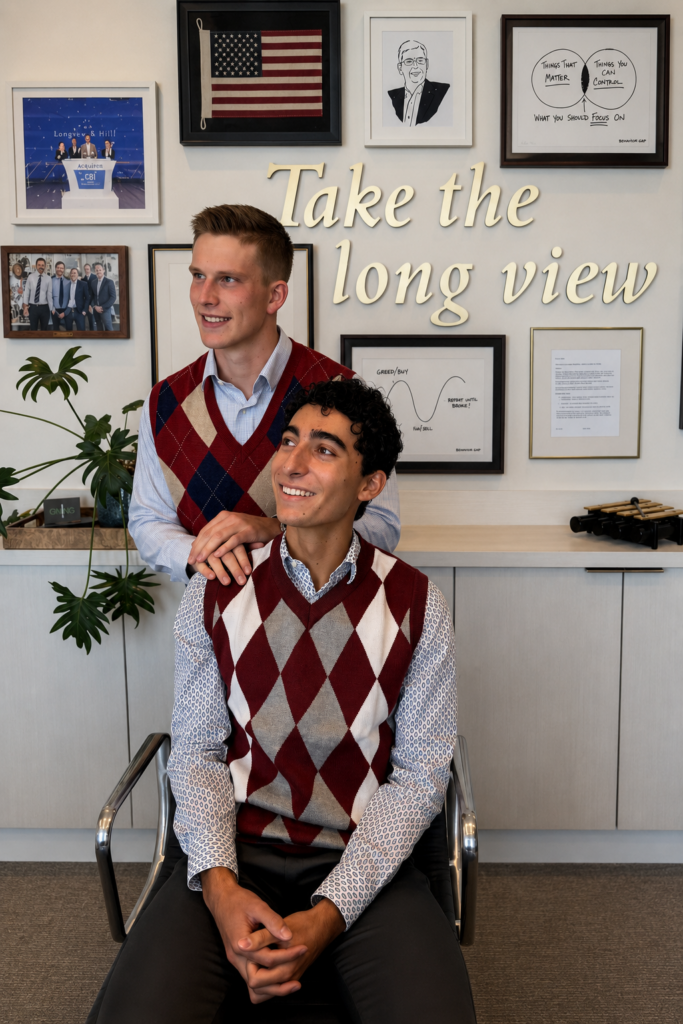
As their summer at Hill came to a close, we asked our interns to reflect on the lessons they’ll carry with them. Their answers touched on investing, leadership, relationships, and a few of the values that shape how we work together every day.
Arriving at Hill, I wanted to prioritize improving my communication to help me become a better leader. Communication channels are more fragmented than ever, and effective leadership increasingly relies on the ability to overcome these obstacles.
At Hill, I learned that candor means more than just vocalizing disagreements. By observing the leaders at Hill, it became obvious that some of the most difficult conversations can be the most fruitful.
The thing I admire most about the leaders at Hill is the way they are able to challenge each other, not to break each other down, but to build each other up. I plan to take this skill with me to help me become a more effective leader, both at work and beyond.
Before this summer, I thought investing was mostly about finding the right answer. At Hill, I learned that the better question is often why.
Every project taught me not to accept something just because that is how it has always been done. At Hill, the focus is on understanding why and asking, “What does the evidence support?”
But the most important lesson I will take away has less to do with investing and more to do with people. The work matters, but the people beside you shape how meaningful and enjoyable that work becomes.
At Hill, fun is not separate from business. It builds the trust, energy, and openness that allow people to do their best work together.
This summer taught me to seek evidence before reaching a conclusion, but it also taught me something even more valuable: when you surround yourself with the right people, meaningful work and fun naturally go together.
What Happens When the Noise Gets Quiet
A few weeks ago, I heard Morgan Housel speak at a conference for top advisors. Many of you may know Morgan from his book, The Psychology of Money, which we often share with clients. We also had him as a guest on my podcast, Take the Long View.
During his talk, Morgan told a story that reminded me of one of my favorite investing lessons.
Everyone knows Warren Buffett. Most people know Charlie Munger. But far fewer people know Rick Guerin.
That’s interesting because Buffett once said Rick was every bit as smart as he and Charlie were. Yet history remembers Buffett and Munger, while most investors have never heard of Rick.
So what happened?
In the early days, Buffett, Munger, and Guerin invested alongside one another. They shared ideas. By all accounts, Rick was an exceptional investor.
But during the brutal bear market of 1973 and 1974, Rick used leverage. He borrowed money to invest. When markets collapsed, margin calls arrived, and he had to sell.
He sold shares to Warren Buffett.
Years later, Buffett explained the difference between them this way:
That is one of the most important investing lessons there is.
The difference was not intelligence. It was not information. It was not access.
It was patience.
Buffett and Munger built their lives and their portfolios in a way that allowed them to stay in the game. Rick could not, or would not, do the same.
That is why I think this story is bigger than investing. It is really about compounding.
Compounding only works if you give it enough time.
That applies to investing. It also applies to building a business, raising a family, improving your health, and developing meaningful friendships and relationships. The biggest rewards often come from years of steady progress that may not look very exciting in the moment.
I have seen that firsthand.
When we started Hill Investment Group in 2005, there was no shortcut. There was no trick. There was simply a commitment to do the right things repeatedly. Serve clients well. Stay disciplined. Keep learning. Think long-term. Allow time to do what time does best.
Now, 21 years later, one of the things I appreciate most is this:
That is true in investing. It is true in business. And I think it is true in life.
The next time markets get noisy, or life gets noisy, I hope you remember the story of Rick Guerin.
Not because he failed, but because his story reminds us that success is often less about brilliance and more about patience.
That is what Taking the Long View is all about.