Signal vs. Noise: Stock Market Concentration Concerns
The Player or the House?
We’re in the Hospitality Business
Client-Exclusive Webinar with David Booth, Co-Founder and Chairman of Dimensional
A Good Estate Plan Should Make Life Easier
Category: Podcast
Podcast Spotlight: Evidence-Based Perspectives in Today’s Markets
Markets continue to generate plenty of headlines – from AI and rising stock prices to questions about whether a handful of companies have become too dominant.
In a recent conversation on the Excess Returns podcast, our HIG and Longview Research Partners CIO Matt Zenz discusses how an evidence-based investment process helps investors stay focused on what matters most, without relying on predictions or market timing.
Topics include:
- Should today’s market concentration should concern long-term investors?
- Why do valuations matter, and when do they matter most?
- How thoughtful implementation can improve long-term investment outcomes.
- Why taxable fixed income may be one of the biggest remaining opportunities to improve after-tax returns.
The discussion also explores Longview’s philosophy behind the Longview Advantage ETFs, including EBI and LVIG, and why disciplined implementation can add value over time.
Listen to the full conversation here:
We Asked a $1 Billion Quant Manager Why Concentration Isn’t a Warning — and Small Caps Aren’t Dead.
Or listen on Spotify or Apple Podcasts.
Prospectus can be found by visiting this page.
You should consider the investment objectives, risks, and charges and expenses carefully before you invest in the Longview Advantage Fund (the “Fund”). The Fund’s prospectus or summary prospectus, which can be obtained by visiting www.longviewresearchpartners.com, contains this and other information about the fund, and should be read carefully before investing.
Investing involves risk, including possible loss of principal.Fixed Income Securities Risk. Fixed-income securities are subject to the risk of the issuer’s inability to meet principal and interest payments on its obligations (i.e., credit risk) and are subject to price volatility resulting from, among other things, interest rate sensitivity, market perception of the creditworthiness of the issuer, willingness of broker-dealers and other market participants to make markets in the applicable securities, and general market liquidity.Distributed by Quasar Distributors, LLC. Quasar is not related to Hill Investment Group Partners, LLC d/b/a Longview Research Partners, the fund’s Investment Adviser.
Long View Summer Reads
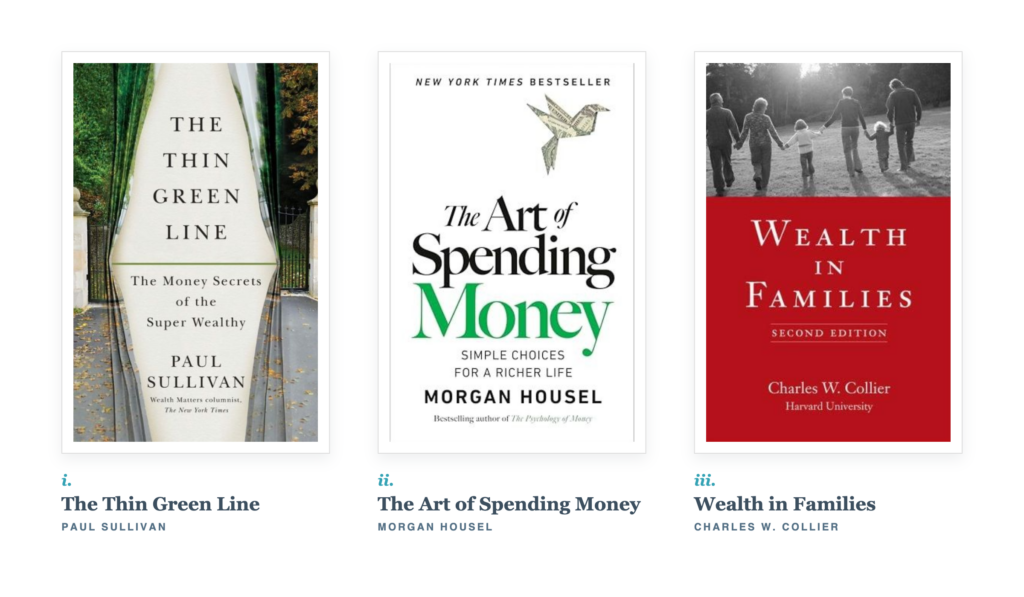 As we’ve kicked of the official start to summer, many of our clients and friends are looking for some great reading material that different than the New York Times list. Further, after our recent webinar with Marilyn Wechter, we asked her to share a few of her favorite books that explore families and their relationship with money that go a bit deeper than what we could cover in just an hour. Some we’ve highly recommended before and others are new.
Enjoy! If you have any questions about what you read or a book sparks a desire to dig deeper, have a conversation, or hold a family meeting to discuss the topic, we’re here to answer questions and facilitate conversations. That’s how families stay together and multi-generational wealth is both created and perpetuates itself. Open communication.
Here we go:
- The Thin Green Line – Paul Sullivan
- The Art of Spending Money – Morgan Housel (Bonus points if you also listen to Matt’s podcast episode here with Morgan)
- Wealth in Families – Charles Collier
Finally, as we continue to celebrate the 10th Anniversary of Odds On, please consider sending a copy (book, Kindle, or audiobook) to someone you are trying to help whether it be a family member or friend. I say “help” very intentionally because why else would you make any recommendation to anyone? You are simply trying to be helpful, and HIG is working to make it easy for you to show up in that role, because that spirit of helpfulness is one of the qualities we value most in our clients and friends of the firm. Request Odds On here.
We can’t wait to hear from you.
When Finance Gurus and Research Disagree
Personal finance advice reaches most people through magazines, TV, bestsellers, podcasts, and radio, not through academic researchers.
In this episode of The Behavioral Divide, Professor Hal Hershfield talks with Yale finance professor James Choi about what he found after analyzing the 50 most popular personal finance books. They discuss where the books get it right, where they diverge from the evidence, and which academic findings could meaningfully strengthen real-world advice.
This podcast is a clear reminder to stay grounded in what the data supports, especially when the loudest guidance is often the easiest to oversimplify. Looking for additional research? Reach out to us to talk more about this.