Signal vs. Noise: Stock Market Concentration Concerns
The Player or the House?
We’re in the Hospitality Business
Client-Exclusive Webinar with David Booth, Co-Founder and Chairman of Dimensional
A Good Estate Plan Should Make Life Easier
Category: Philosophy
Am I Actually Okay?

If you’re a client, we hope you were able to join us on May 14, 2026, for a thoughtful webinar featuring Marilyn Wechter, nationally recognized wealth counselor and psychotherapist who helps families navigate the emotional side of money. Like Carl Richards, Marilyn has the gift of helping families deal with money and emotion; however, she comes at it with an entirely different perspective.
Specifically, Marilyn helped us all explore the question, “Am I really OK (financially)?” where there is sometimes a misalignment between our rational brain (numbers, spreadsheets, and probabilities) and our emotional brain (how we are actually feeling about our situation). Often, our emotional brain “wins” despite “knowing” we’re OK.
To understand the topic in more detail, we’d be happy to send you the full recording. If you’d like to see the highlight reel in 5 minutes, click play on the video above.
In addition, all of our clients know that we’re always available to discuss these issues in more detail.
Long View Summer Reads
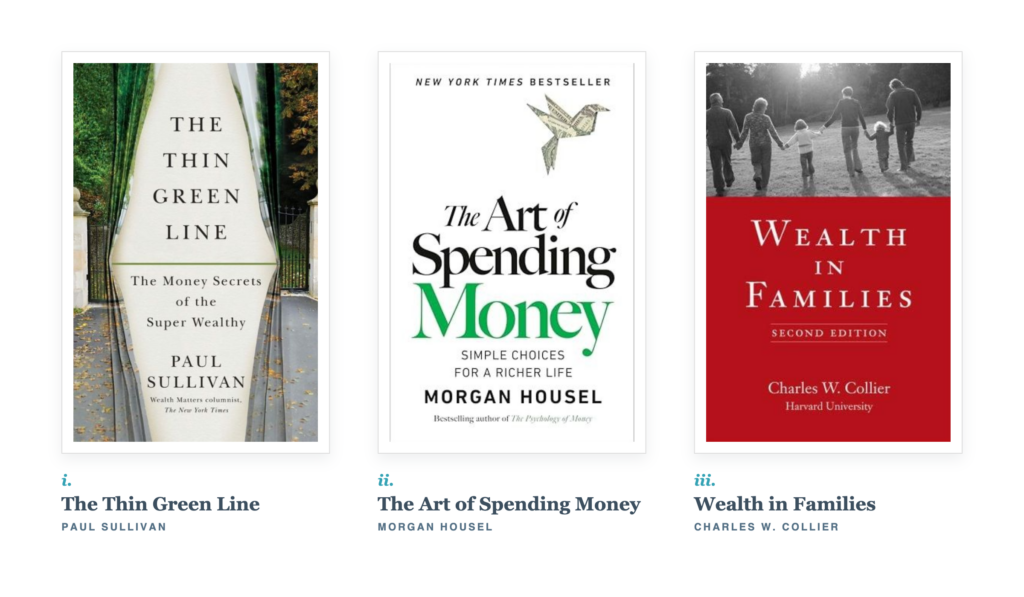 As we’ve kicked of the official start to summer, many of our clients and friends are looking for some great reading material that different than the New York Times list. Further, after our recent webinar with Marilyn Wechter, we asked her to share a few of her favorite books that explore families and their relationship with money that go a bit deeper than what we could cover in just an hour. Some we’ve highly recommended before and others are new.
Enjoy! If you have any questions about what you read or a book sparks a desire to dig deeper, have a conversation, or hold a family meeting to discuss the topic, we’re here to answer questions and facilitate conversations. That’s how families stay together and multi-generational wealth is both created and perpetuates itself. Open communication.
Here we go:
- The Thin Green Line – Paul Sullivan
- The Art of Spending Money – Morgan Housel (Bonus points if you also listen to Matt’s podcast episode here with Morgan)
- Wealth in Families – Charles Collier
Finally, as we continue to celebrate the 10th Anniversary of Odds On, please consider sending a copy (book, Kindle, or audiobook) to someone you are trying to help whether it be a family member or friend. I say “help” very intentionally because why else would you make any recommendation to anyone? You are simply trying to be helpful, and HIG is working to make it easy for you to show up in that role, because that spirit of helpfulness is one of the qualities we value most in our clients and friends of the firm. Request Odds On here.
We can’t wait to hear from you.
Signal vs. Noise: What State Pension Funds Can Teach Investors About Chasing Performance

State pension funds are often viewed as the “smart money” of the investment world.
They employ large internal investment staffs. They hire teams of consultants. They have access to private investments unavailable to most investors. They negotiate lower fees because of their enormous scale. They conduct deep due diligence on hedge funds, private equity managers, venture capital firms, and real estate partnerships.
In theory, if anyone should outperform a simple index portfolio, it should be them.
Yet the evidence tells a very different story.
A well-known paper by Jeffrey Hooke and John Walters, “Wall Street Fees and Investment Returns for 33 State Pension Funds,” examined the results of large public pension systems and compared them to low-cost passive benchmarks. The conclusion was striking: the median pension fund underperformed a basic indexed portfolio by roughly 1.6% annually over the study period.
That gap may not sound large at first glance, but compounded over decades, it becomes enormous.
More Complexity Did Not Lead to Better Results
Over the past two decades, many pension funds have dramatically increased their exposure to:
- Private equity
- Hedge funds
- Venture capital
- Tactical asset allocation
- Alternative credit
- Real assets
- “Opportunistic” strategies
These investments are often marketed as sophisticated tools capable of delivering higher returns, downside protection, or diversification benefits unavailable in public markets.
But despite all of the resources available to these institutions, the end results frequently disappointed.
Importantly, many of these pension portfolios were also taking more risk than a traditional 60/40 stock and bond portfolio. They often had:
- Higher equity exposure
- Significant leverage embedded in private investments
- Illiquid assets
- Increased credit risk
- More aggressive return assumptions
In other words, many pensions were not underperforming because they were conservative. They were underperforming despite taking greater risks and paying substantially higher fees.
The Cost of Chasing “What’s Next”
One of the most persistent themes in investing is the belief that there must always be a better answer somewhere else:
- A smarter manager
- A new asset class
- A more complicated strategy
- A niche product that can unlock hidden returns
But investing evidence has consistently shown that expected returns are driven primarily by exposure to compensated risks, not complexity.
Chasing fashionable investments or attempting to time markets often introduces:
- Higher fees
- Greater taxes
- More operational friction
- Behavioral mistakes
- Lower transparency
- Increased implementation challenges
And those costs compound quietly over time.
The pension fund experience is a powerful reminder that access alone does not create better outcomes.
Simplicity Is Often an Advantage
At Hill Investment Group, we believe investors are generally better served by focusing on:
- Broad diversification
- Evidence-based sources of expected return
- Low costs
- Tax efficiency
- Disciplined implementation
- Long-term behavior
This does not mean investors should avoid innovation or thoughtful portfolio design. But complexity should have a very high burden of proof.
The reality is that many of the world’s largest and most sophisticated institutions have struggled to outperform simple, low-cost indexed approaches, despite having every conceivable advantage.
For most investors, the lesson is not that investing is easy. It is that successful investing often requires resisting the constant pressure to make it unnecessarily complicated.