Signal vs. Noise: Stock Market Concentration Concerns
A New Book, A Familiar Message: Stay Calm
The Freedom to Choose What Comes Next
Living Our Values: Reflections From Hill’s 2026 Summer Interns
The Player or the House?
Category: Philosophy
The Player or the House?

August has been a month of goodbyes for me.
Lisa and I just dropped off our only child at college. Like every parent who has reached this milestone, I’m feeling a strange mix of pride, excitement, and disbelief that we’re already here.
I’m also feeling pretty good about one other thing: that 529 account we’ve been diligently funding for years is now ready and willing to be depleted. 🙂
Back at Hill, we’re saying goodbye to two other young people: our summer interns.
For 16 years, we’ve had an internship program at Hill, and it has been one of those things that has worked well for everyone involved. We get to teach smart young people about our business, evidence-based investing, and what we’ve learned along the way. They get real exposure to a working investment firm. And, yes, they also help us with some of the work no one else is exactly fighting to do.
Our process is pretty simple. In the fall, we begin collecting interest. Interviews start in January, and we generally make our decisions by mid-March. Depending on the strength of the pool, we hire anywhere from zero to three interns.
This year, we had two of the best we’ve ever had.
They didn’t just show up and take from our culture. They contributed to it. They asked good questions, did good work and made Hill better while they were here. By the end of the summer, we honestly didn’t want them to leave.
Then they did something that made me even more impressed with them: they introduced us to several friends they thought might be great Hill interns next summer. Think about that. They were helping us, helping their friends and putting their own reputations behind the experience they had here.
So I took a few of these prospective interns to lunch.
One of them, a student-athlete at Washington University, asked me a terrific question:
“I know people who manage big money, pick stocks (rather than take an evidence-based approach), and do quite well. What do you say to that?”
I loved the question because it gets at one of the foundational reasons Hill Investment Group exists.
There were five of us sitting at the table, so I said:
“Imagine the five of us take a trip to Vegas. You have a choice. You can be a player or the house. Which would you choose?”
Without hesitating, he said, “I’d be the house.”
“Why?” I asked.
“Because the math is figured out. The odds are on your side.”
Exactly.
We want to be the house.
A player can win tonight. He might win tomorrow night. He might even have an incredible weekend and come home convinced he has figured out Vegas.
But over enough time and enough bets, the house has the advantage.
Investing is different from gambling, of course, but the lesson about odds is remarkably similar. We don’t believe our job is to guess which stock will outperform next year or find the person who had the hottest hand last year. There will always be people who win that game for a while.
We would rather put the odds on our side over the long haul (or Hall).
That means letting markets work for us. Diversifying. Keeping costs and taxes in mind. Staying disciplined when other people aren’t. And accepting that a sound process can sometimes lose to a lucky outcome in the short run.
It’s less exciting than believing someone has discovered the next great stock.
It’s also much more durable.
That’s what we believe to our core at Hill. It’s what we teach our interns. It’s how we invest our own money. It’s how we build our ETFs. And it’s the philosophy we hope these two young people carry with them long after they’ve forgotten whatever projects we made them work on this summer.
Whether you’re heading off to college, beginning a career or investing for the next several decades, you can’t control how everything turns out.
But you can do an awful lot to put the odds on your side.
Take the Long View,
Closing the Gap
Why the biggest challenge in investing is seeing clearly.
20+ years ago, I was sitting in a conference room when my former boss abruptly stopped the conversation. He wasn’t an imposing man physically. In fact, he was rather petite. But when he decided to make a point, the entire room listened. Looking directly at me, he said, almost as if he wanted to make sure I’d remember it years later: “Perception is reality.”
I remember thinking, That can’t be right. Surely reality wasn’t determined by how someone happened to perceive it. For years, I resisted the lesson.
Eventually, though, I realized there was a deeper truth inside it. My boss wasn’t saying facts don’t matter. He was reminding me that our decisions are driven by how we interpret those facts. I’ve thought about that conversation many times over the years, and it cropped up again recently when I came across a fascinating chart:
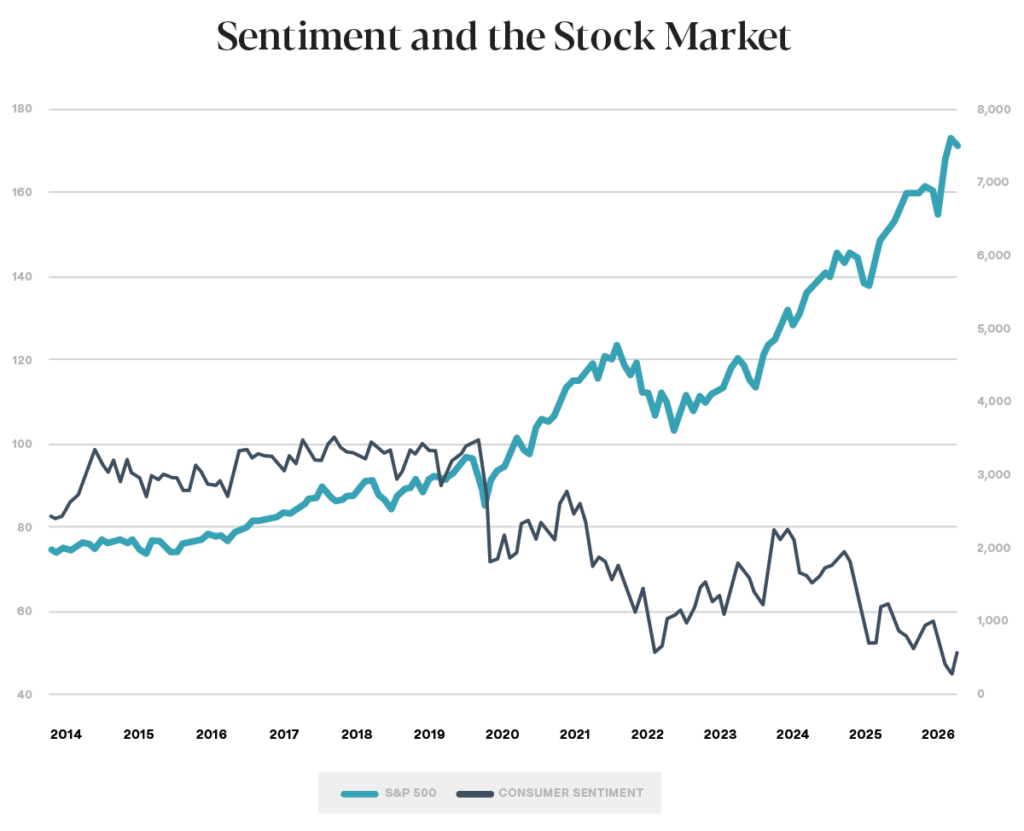
The chart compares consumer sentiment (how we feel) with the performance of the U.S. stock market over the past 13 years (what happened). Intuitively, you’d expect the two to move together. If Americans are becoming wealthier, surely we should feel better. Instead, the two lines move in almost opposite directions.
Markets have boomed, retirement accounts have grown, investment portfolios have appreciated, and yet consumer sentiment is down…way down. Some investors feel worse even as they have, in many cases, been getting richer.
That disconnect reminds us that the hardest part of investing often isn’t what the market is doing. It’s accurately perceiving what’s happening while we’re living through it.
Every day we’re bombarded with information designed to capture our attention—not improve our judgment. Headlines compete for clicks. Social media rewards outrage. Every scroll offers another crisis, another prediction, another reason to worry.
At the same time, businesses continue to innovate. Workers continue to create value. Companies continue to earn profits. Diversified investors quietly participate in that growth.
Both realities exist at the same time.
The question is which one shapes our decisions.
That question, I believe, gets to the heart of investing. Because the biggest challenge isn’t finding great investments. It’s keeping our perception aligned with reality long enough to benefit from them.
Good advice doesn’t eliminate uncertainty. It helps us respond to uncertainty in better ways. It encourages patience when fear is loud. It provides perspective when the news cycle is overwhelming. It reminds us that our greatest investment decisions are rarely made in moments of excitement or panic, but through the quiet discipline of sticking with a thoughtful plan. It’s not exciting. It’s often downright boring. But it’s true. And over long periods, it’s remarkably effective.
We often talk about closing the gap between investment returns and investor returns. Investors frequently underperform the very investments they own because their perceptions lead them to buy and sell at exactly the wrong times.
Maybe that’s really just a symptom of a deeper gap.
The gap between perception and reality.
At Hill, you know what we call this idea. We call it taking the long view.
And by the way, I eventually realized my old boss was only half right.
Perception isn’t reality. But perception drives behavior. And behavior shapes outcomes.
Markets don’t require us to be smarter than everyone else. They don’t ask us to predict elections, guess interest rates, or identify the next Nvidia before anyone else. They ask something much simpler: to see clearly.
Our job isn’t simply to manage portfolios.
It’s to help our clients close the gap between perception and reality so they can capture more of what the markets have been offering all along.
What Happens When the Noise Gets Quiet
A few weeks ago, I heard Morgan Housel speak at a conference for top advisors. Many of you may know Morgan from his book, The Psychology of Money, which we often share with clients. We also had him as a guest on my podcast, Take the Long View.
During his talk, Morgan told a story that reminded me of one of my favorite investing lessons.
Everyone knows Warren Buffett. Most people know Charlie Munger. But far fewer people know Rick Guerin.
That’s interesting because Buffett once said Rick was every bit as smart as he and Charlie were. Yet history remembers Buffett and Munger, while most investors have never heard of Rick.
So what happened?
In the early days, Buffett, Munger, and Guerin invested alongside one another. They shared ideas. By all accounts, Rick was an exceptional investor.
But during the brutal bear market of 1973 and 1974, Rick used leverage. He borrowed money to invest. When markets collapsed, margin calls arrived, and he had to sell.
He sold shares to Warren Buffett.
Years later, Buffett explained the difference between them this way:
That is one of the most important investing lessons there is.
The difference was not intelligence. It was not information. It was not access.
It was patience.
Buffett and Munger built their lives and their portfolios in a way that allowed them to stay in the game. Rick could not, or would not, do the same.
That is why I think this story is bigger than investing. It is really about compounding.
Compounding only works if you give it enough time.
That applies to investing. It also applies to building a business, raising a family, improving your health, and developing meaningful friendships and relationships. The biggest rewards often come from years of steady progress that may not look very exciting in the moment.
I have seen that firsthand.
When we started Hill Investment Group in 2005, there was no shortcut. There was no trick. There was simply a commitment to do the right things repeatedly. Serve clients well. Stay disciplined. Keep learning. Think long-term. Allow time to do what time does best.
Now, 21 years later, one of the things I appreciate most is this:
That is true in investing. It is true in business. And I think it is true in life.
The next time markets get noisy, or life gets noisy, I hope you remember the story of Rick Guerin.
Not because he failed, but because his story reminds us that success is often less about brilliance and more about patience.
That is what Taking the Long View is all about.