Signal vs. Noise: Stock Market Concentration Concerns
The Player or the House?
We’re in the Hospitality Business
Client-Exclusive Webinar with David Booth, Co-Founder and Chairman of Dimensional
A Good Estate Plan Should Make Life Easier
Tag: investment strategy
The 10-Year Treasury Hit 5%. Now What?

The yield on the 10-year U.S. Treasury recently crossed 5%, a level that has attracted plenty of attention in the financial media. That makes sense. Five percent is a memorable number.
From an investment perspective, though, there is nothing magical about 5%.
Interest rates matter. Changes in rates affect borrowing costs, bond yields, business decisions, and the broader economy. But a Treasury yield crossing an arbitrary round number does not suddenly make the information more useful for making investment decisions.
The better question is whether anything about the current interest-rate environment should cause us to change the way we invest.
We don’t believe it should.
Bond markets are forward-looking. Before the Federal Reserve’s most recent rate increase, Treasury yields had already moved higher as investors increasingly expected the Fed to act. When the Fed finally announced the increase, relatively little happened to yields because the market had already anticipated the news.
More importantly, every dollar in a portfolio has a job. Stocks are primarily responsible for long-term growth, while bonds tend to preserve capital and insulate portfolios from large stock market swings.
Higher rates don’t change that job. In fact, higher yields generally improve the return potential of bonds going forward. Earning a little more from the part of the portfolio designed for stability isn’t a bad outcome.
Higher interest rates are frequently presented as bad news for stocks because they increase financing costs. But the relationship isn’t nearly that simple. The Federal Reserve often raises rates when economic conditions are strong and cuts them when economic conditions weaken. These competing narratives – higher financing costs versus a strong economy – make it difficult to predict if rising rates might be good or bad for stocks. Market participants make this evaluation every day and reflect those expectations in stock prices.
Rather than trying to decide which story sounds better, let’s study the data.
We looked at the historical record of US stock market returns and interest rate changes from 1979 through 2025, then we separated calendar years based on whether the 10-year Treasury yield rose or fell during the year.
The results are remarkably similar.
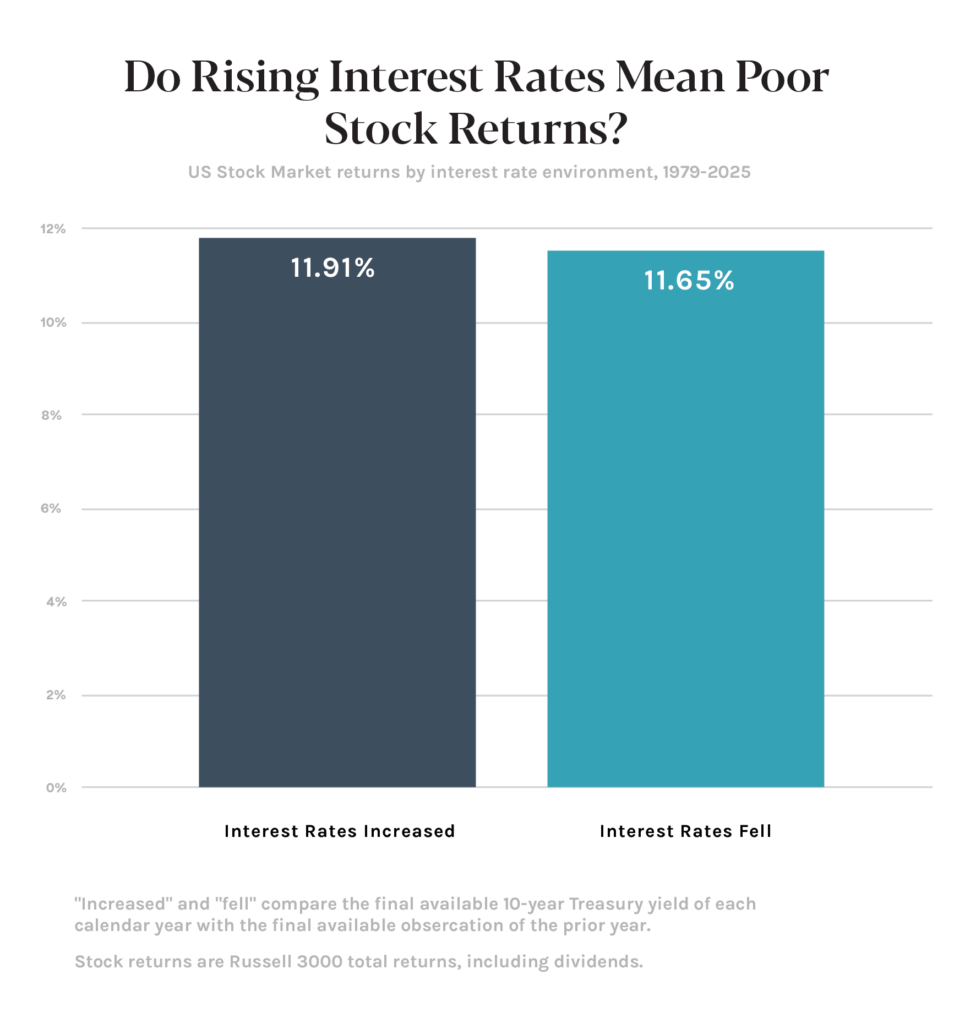
In years where rates increased, US stocks delivered an average return of 11.9%. In years where rates decreased, the average return was 11.6%. A difference of just 0.3%.
The takeaway is not that rising rates are good or bad for stocks. It is that markets incorporate expectations about changing interest rates into stock prices. Investors don’t need to predict the direction of rates to capture the long-term returns stocks are expected to provide.
Rising rates do not spell doom for stocks, nor do they provide a reason to change a well-designed financial plan. Historically, the direction of interest rates has told us very little about future stock market returns.
For investors, there is no special significance to the 10-year Treasury yielding 5% instead of 4.9%. It is a round number that makes for an interesting headline, but it doesn’t change the role of stocks or bonds in a well-designed portfolio.
Bonds still have the same job in our portfolios: preserving capital and dampening stock market swings. Higher yields simply allow them to earn more while doing it.
Our stock investments remain the portfolio’s primary source of long-term growth. Nearly five decades of market history give us little reason to treat rising interest rates as a useful signal about future stock returns.
Financial headlines will change. Round numbers will come and go. The principles behind a well-designed investment plan don’t change with them.
Closing the Gap
Why the biggest challenge in investing is seeing clearly.
20+ years ago, I was sitting in a conference room when my former boss abruptly stopped the conversation. He wasn’t an imposing man physically. In fact, he was rather petite. But when he decided to make a point, the entire room listened. Looking directly at me, he said, almost as if he wanted to make sure I’d remember it years later: “Perception is reality.”
I remember thinking, That can’t be right. Surely reality wasn’t determined by how someone happened to perceive it. For years, I resisted the lesson.
Eventually, though, I realized there was a deeper truth inside it. My boss wasn’t saying facts don’t matter. He was reminding me that our decisions are driven by how we interpret those facts. I’ve thought about that conversation many times over the years, and it cropped up again recently when I came across a fascinating chart:
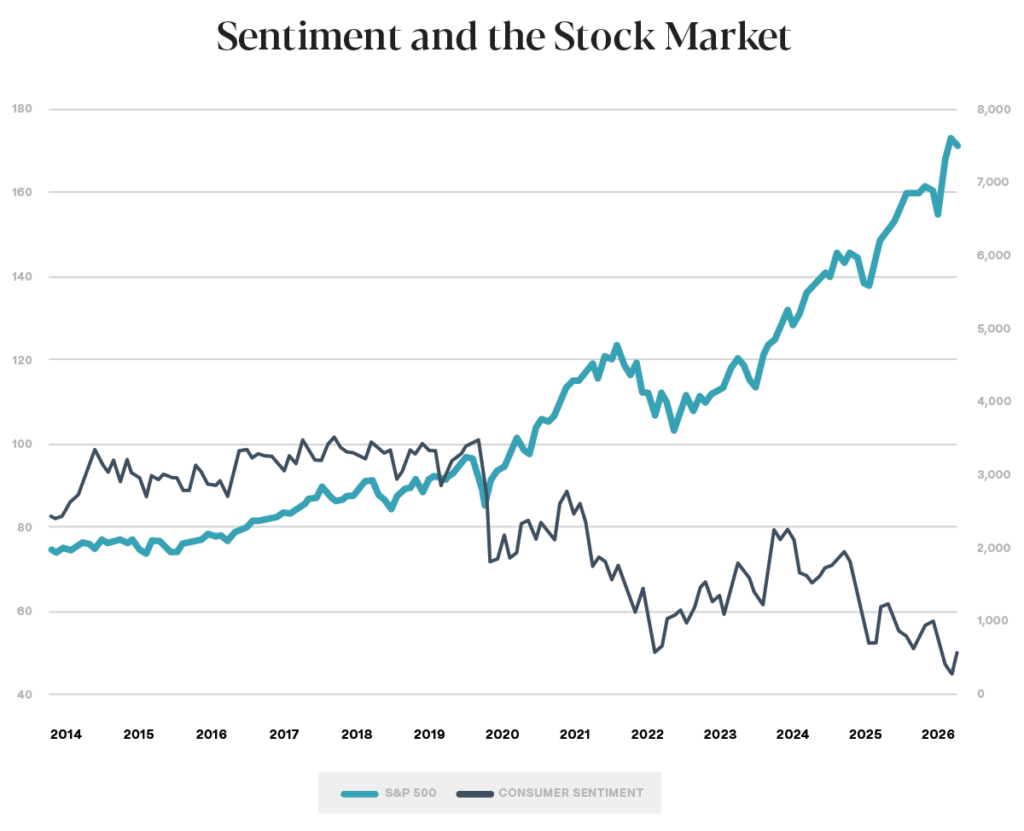
The chart compares consumer sentiment (how we feel) with the performance of the U.S. stock market over the past 13 years (what happened). Intuitively, you’d expect the two to move together. If Americans are becoming wealthier, surely we should feel better. Instead, the two lines move in almost opposite directions.
Markets have boomed, retirement accounts have grown, investment portfolios have appreciated, and yet consumer sentiment is down…way down. Some investors feel worse even as they have, in many cases, been getting richer.
That disconnect reminds us that the hardest part of investing often isn’t what the market is doing. It’s accurately perceiving what’s happening while we’re living through it.
Every day we’re bombarded with information designed to capture our attention—not improve our judgment. Headlines compete for clicks. Social media rewards outrage. Every scroll offers another crisis, another prediction, another reason to worry.
At the same time, businesses continue to innovate. Workers continue to create value. Companies continue to earn profits. Diversified investors quietly participate in that growth.
Both realities exist at the same time.
The question is which one shapes our decisions.
That question, I believe, gets to the heart of investing. Because the biggest challenge isn’t finding great investments. It’s keeping our perception aligned with reality long enough to benefit from them.
Good advice doesn’t eliminate uncertainty. It helps us respond to uncertainty in better ways. It encourages patience when fear is loud. It provides perspective when the news cycle is overwhelming. It reminds us that our greatest investment decisions are rarely made in moments of excitement or panic, but through the quiet discipline of sticking with a thoughtful plan. It’s not exciting. It’s often downright boring. But it’s true. And over long periods, it’s remarkably effective.
We often talk about closing the gap between investment returns and investor returns. Investors frequently underperform the very investments they own because their perceptions lead them to buy and sell at exactly the wrong times.
Maybe that’s really just a symptom of a deeper gap.
The gap between perception and reality.
At Hill, you know what we call this idea. We call it taking the long view.
And by the way, I eventually realized my old boss was only half right.
Perception isn’t reality. But perception drives behavior. And behavior shapes outcomes.
Markets don’t require us to be smarter than everyone else. They don’t ask us to predict elections, guess interest rates, or identify the next Nvidia before anyone else. They ask something much simpler: to see clearly.
Our job isn’t simply to manage portfolios.
It’s to help our clients close the gap between perception and reality so they can capture more of what the markets have been offering all along.
Signal vs. Noise: What State Pension Funds Can Teach Investors About Chasing Performance
State pension funds are often viewed as the “smart money” of the investment world.
They employ large internal investment staffs. They hire teams of consultants. They have access to private investments unavailable to most investors. They negotiate lower fees because of their enormous scale. They conduct deep due diligence on hedge funds, private equity managers, venture capital firms, and real estate partnerships.
In theory, if anyone should outperform a simple index portfolio, it should be them.
Yet the evidence tells a very different story.
A well-known paper by Jeffrey Hooke and John Walters, “Wall Street Fees and Investment Returns for 33 State Pension Funds,” examined the results of large public pension systems and compared them to low-cost passive benchmarks. The conclusion was striking: the median pension fund underperformed a basic indexed portfolio by roughly 1.6% annually over the study period.
That gap may not sound large at first glance, but compounded over decades, it becomes enormous.
More Complexity Did Not Lead to Better Results
Over the past two decades, many pension funds have dramatically increased their exposure to:
- Private equity
- Hedge funds
- Venture capital
- Tactical asset allocation
- Alternative credit
- Real assets
- “Opportunistic” strategies
These investments are often marketed as sophisticated tools capable of delivering higher returns, downside protection, or diversification benefits unavailable in public markets.
But despite all of the resources available to these institutions, the end results frequently disappointed.
Importantly, many of these pension portfolios were also taking more risk than a traditional 60/40 stock and bond portfolio. They often had:
- Higher equity exposure
- Significant leverage embedded in private investments
- Illiquid assets
- Increased credit risk
- More aggressive return assumptions
In other words, many pensions were not underperforming because they were conservative. They were underperforming despite taking greater risks and paying substantially higher fees.
The Cost of Chasing “What’s Next”
One of the most persistent themes in investing is the belief that there must always be a better answer somewhere else:
- A smarter manager
- A new asset class
- A more complicated strategy
- A niche product that can unlock hidden returns
But investing evidence has consistently shown that expected returns are driven primarily by exposure to compensated risks, not complexity.
Chasing fashionable investments or attempting to time markets often introduces:
- Higher fees
- Greater taxes
- More operational friction
- Behavioral mistakes
- Lower transparency
- Increased implementation challenges
And those costs compound quietly over time.
The pension fund experience is a powerful reminder that access alone does not create better outcomes.
Simplicity Is Often an Advantage
At Hill Investment Group, we believe investors are generally better served by focusing on:
- Broad diversification
- Evidence-based sources of expected return
- Low costs
- Tax efficiency
- Disciplined implementation
- Long-term behavior
This does not mean investors should avoid innovation or thoughtful portfolio design. But complexity should have a very high burden of proof.
The reality is that many of the world’s largest and most sophisticated institutions have struggled to outperform simple, low-cost indexed approaches, despite having every conceivable advantage.
For most investors, the lesson is not that investing is easy. It is that successful investing often requires resisting the constant pressure to make it unnecessarily complicated.