Signal vs. Noise: Stock Market Concentration Concerns
The Player or the House?
We’re in the Hospitality Business
Client-Exclusive Webinar with David Booth, Co-Founder and Chairman of Dimensional
A Good Estate Plan Should Make Life Easier
Category: Timely Topic
Signal vs. Noise: Great Companies Don’t Always Make for Great Investments. The Evidence Around IPOs.

On June 11th, Space Exploration Technologies, better known as SpaceX (SPCX), began trading on Nasdaq. The headlines were everywhere: A $1.75 trillion valuation. The largest IPO in stock market history. The media is suggesting that this is a once-in-a-generation opportunity.
The noise around IPOs is likely to continue throughout 2026, with more large IPOs planned this year, including OpenAI (known for ChatGPT) and Anthropic (known for Claude.ai).
These companies may change the world as we know it. Maybe not. As investors, we can be excited about these companies, but the evidence tells a clear story about IPOs and how we should treat them in our portfolio.
What the Evidence Shows on IPOs
Based on research from Dimensional Fund Advisors (DFA), we can examine IPO performance across two timeframes: short and medium-term.
Over the short term (first trading day), IPOs typically perform well. This phenomenon is often referred to as the “IPO Pop.” Insiders and some large institutions can buy shares at the IPO price (unavailable to the public) and sell them at higher prices on the open market. Thus, the positive return from the IPO Pop is reserved for insiders and unavailable to the average investor. Individuals can only access shares on the open market meaning after the shares start trading. Often, investors may have to pay higher prices, thereby decreasing (or eliminating) the day-one returns that we see in the data and which the media loves to hype.
After the IPO Pop, over the next six to twelve months after listing, IPOs tend to lag the broader US stock market by 2-3% per year. Please reread the last sentence.
Obviously, these trends may not happen every time. Any individual IPO stock may be different. But the point is that, on average, IPOs tend not to be great investments, particularly when they have high valuations and negative profits, like SpaceX.
An Evidence-Based Alternative
There is good news here. As always, we can leverage this data and evidence to build better portfolios. The funds that we use at HIG typically wait for the IPO hype to fade and for insiders’ lock-up periods to end (increasing the supply of shares) before buying newly listed companies. What does this mean? We expect that, over time, all of our clients will have an appropriate allocation to many of these newly listed companies in the six to twelve-month timeframe as they meet the evidence-based criteria for inclusion in the portfolio.
The Temptation Is Real
We understand the emotional pull. When something feels “historic,” sitting on the sidelines can feel like missing out.
As advisors, our job is to keep clients focused on what the evidence says, not what the moment feels like. The same discipline that keeps you from panic-selling in a downturn is the same discipline that keeps you from buying into a frenzy.
A great company is worth rooting for. It is not always worth buying.
If you’d like to continue this discussion, please reach out to me at ryan@hillinvestmentgroup.com.
Tax Drag: The Hidden Cost Investors Overlook
One of our outstanding 2026 Summer Interns, Sebastian Peritore, collaborated with Nell Schiffer to write this article.
A recent piece in the WSJ makes the case that investors’ priorities can be misaligned when picking which investment funds to place their money in. Captivated by chasing returns, investors often lose sight of the most consequential factors.
When choosing an investment fund, most investors focus on returns.
That’s understandable. Performance numbers are easy to find, easy to compare, and often dominate marketing materials.
But by focusing too heavily on returns, investors can overlook a factor that may have an even greater impact on long-term wealth: taxes.
Avoiding a Common Mistake
Not all investment funds are created equal.
Decades of research show that investors who try to pick winning stocks or time the market face long odds. While some managers outperform for short periods, taxes and fees often erode those gains over time.
As a result, many investors have embraced low-cost index funds that allow them to participate in market returns without relying on forecasts or stock-picking skill.
That’s a meaningful step forward. But choosing an index fund is only part of the equation.
What Many Investors Overlook
Most investors compare funds based on historical returns and expense ratios. Both matter.
What many investors fail to consider is how much of those returns they actually keep after taxes.
Most mutual funds highlight pre-tax performance, while the tax consequences of owning the fund receive far less attention. Yet research cited in a recent Wall Street Journal article suggests that taxes can reduce an investor’s accumulated wealth by nearly one-third over time.
In other words, investors may spend considerable effort searching for a slightly higher return while overlooking a factor that can have a far greater impact on their long-term results.
Keeping More of What You Earn
Successful investing requires more than pursuing returns. It requires keeping as much of those returns as possible.
That’s why we believe investors should evaluate returns, costs, and tax efficiency together rather than in isolation.
At Hill, we look for opportunities to combine evidence-based investing with thoughtful innovation to help clients keep more of what they earn.
One example is the Longview Advantage Fixed Income ETF (NASDAQ: LVIG). LVIG is a fixed-income ETF structured as a fund of funds and designed to reduce some of the tax friction that income distributions can create in taxable accounts.
The Long View
The most successful investors don’t simply focus on what they earn. They focus on what they keep.
Over a lifetime of investing, even small differences can compound into meaningful outcomes. A seemingly minor drag on performance, repeated year after year, can have a significant impact on long-term wealth.
That’s why taxes deserve a seat at the investment table alongside returns and fees.
Investors who avoid overlooking tax implications put themselves in a stronger position to preserve more of their wealth and stay focused on what matters most: taking the long view®.
Long View Summer Reads
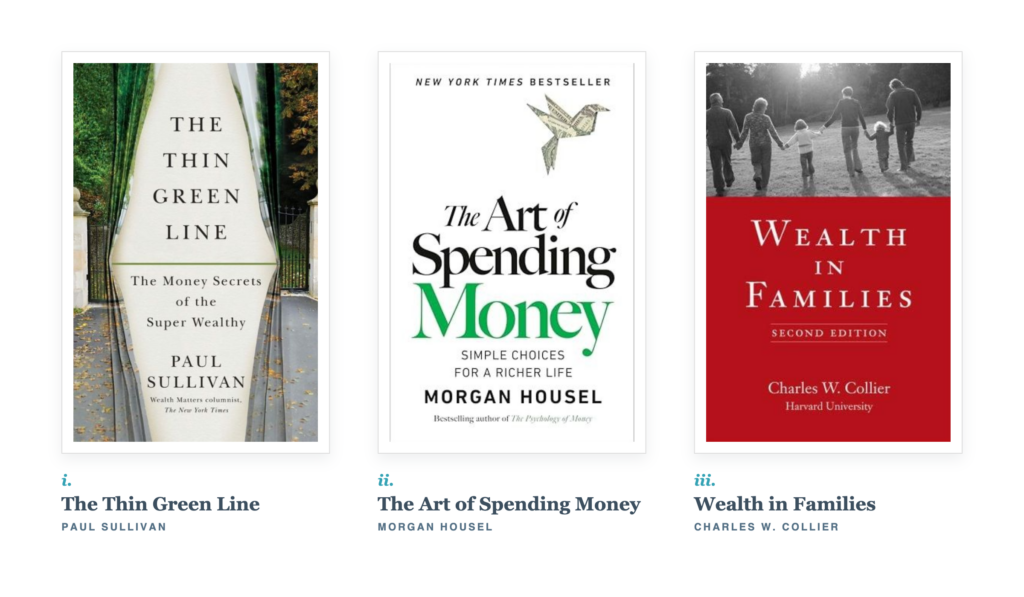 As we’ve kicked of the official start to summer, many of our clients and friends are looking for some great reading material that different than the New York Times list. Further, after our recent webinar with Marilyn Wechter, we asked her to share a few of her favorite books that explore families and their relationship with money that go a bit deeper than what we could cover in just an hour. Some we’ve highly recommended before and others are new.
Enjoy! If you have any questions about what you read or a book sparks a desire to dig deeper, have a conversation, or hold a family meeting to discuss the topic, we’re here to answer questions and facilitate conversations. That’s how families stay together and multi-generational wealth is both created and perpetuates itself. Open communication.
Here we go:
- The Thin Green Line – Paul Sullivan
- The Art of Spending Money – Morgan Housel (Bonus points if you also listen to Matt’s podcast episode here with Morgan)
- Wealth in Families – Charles Collier
Finally, as we continue to celebrate the 10th Anniversary of Odds On, please consider sending a copy (book, Kindle, or audiobook) to someone you are trying to help whether it be a family member or friend. I say “help” very intentionally because why else would you make any recommendation to anyone? You are simply trying to be helpful, and HIG is working to make it easy for you to show up in that role, because that spirit of helpfulness is one of the qualities we value most in our clients and friends of the firm. Request Odds On here.
We can’t wait to hear from you.